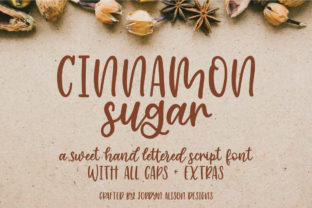
Cinnamon Sugar Script: A Hand Lettered Font for Editorial Charm
As a publisher who crafts digital magazines, branded newsletters, and illustrated ebooks, I’ve spent years testing Script Handwritten fonts that balance personality with professionalism—and Cinnamon Sugar Script stands out immediately. It’s not just another decorative script; it’s a thoughtfully engineered Fonts asset built for editorial designers who need warmth, rhythm, and visual distinction without sacrificing clarity or versatility.
Cinnamon Sugar Script for Magazine Covers and Print-Ready Headlines
Cinnamon Sugar Script delivers the kind of tactile authenticity that makes readers pause mid-scroll—or reach for a print copy before they even finish reading the headline. Its hand-lettered texture gives magazine covers instant character, especially when layered over muted photography or minimalist layouts. The all-caps variant isn’t stiff or formal; instead, it’s bouncy and inviting—ideal for mastheads, seasonal issue titles (“Spring 2024”), or bold cover lines like “The Art of Slow Living.” Because it includes ligatures and stylistic alternates, you can fine-tune spacing and flow to avoid awkward letter collisions—a subtle but critical advantage for tight cover typography where every millimeter counts.
Cinnamon Sugar Script for Ebook Titles and Chapter Openers
When designing an ebook—whether it’s a wellness guide, a poetry collection, or a creator-focused workbook—Cinnamon Sugar Script adds narrative warmth at precisely the right moments. Use it for chapter titles in a serif body (like Adobe Garamond or EB Garamond) to create gentle contrast: the script sets tone and intention, while the serif ensures readability across devices and PDF exports. Its lowercase script flows naturally in short bursts—think “Chapter Three: Begin Again”—and the included alternates let you rotate glyphs to prevent repetition fatigue. For screen reading, pair it sparingly: never for full paragraphs, but always for structural signposts that guide readers emotionally as well as visually.
Cinnamon Sugar Script for Newsletter Graphics and Social Media Quote Cards
Newsletters thrive on voice—and Cinnamon Sugar Script helps your brand sound human, not algorithmic. In Mailchimp or ConvertKit templates, use it for pull quotes pulled from your latest article (“Your inbox deserves more than noise”), or as accent typography in welcome sequences and lead magnet covers (e.g., “Free Printable Planner Inside”). On Instagram or Pinterest, where attention spans are measured in seconds, this Script Handwritten font performs exceptionally well: its organic curves read clearly even at small sizes, and the fun all-caps pairing works beautifully for overlay text on lifestyle or recipe graphics. Just embed it via webfont service or export static PNGs with optimized resolution—no rendering hiccups on mobile feeds.
Cinnamon Sugar Script for Branded Printables and Digital Workbooks
If you sell printable planners, coaching worksheets, or guided journal templates, Cinnamon Sugar Script elevates perceived value instantly. Its handwritten charm signals care and craft—key emotional cues for buyers investing in self-development tools. Use the lowercase script for section headers (“Reflect,” “Plan,” “Celebrate”) and the all-caps version for decorative dividers or title pages. Because it’s a premium font with robust OpenType features—including contextual alternates and discretionary ligatures—you’ll get natural-looking word shapes without manual kerning. Test it in both PDF and editable Canva templates: it renders cleanly across platforms, and commercial licensing covers redistribution in paid digital downloads, making it safe for your shop or Gumroad store.
Cinnamon Sugar Script for Wedding Guides and Lifestyle Blog Headers
Lifestyle bloggers covering weddings, home styling, or seasonal entertaining will find Cinnamon Sugar Script indispensable for establishing mood before a single sentence is read. On blog headers, it transforms generic headings like “Fall Entertaining Tips” into evocative invitations—“gather • share • savor”—especially when paired with soft sans serif body text (Inter or Poppins). In wedding planning ebooks or vendor directories, its warmth reinforces intimacy and personal connection. The Script Handwritten quality feels intentional, not generic; it avoids the dated whimsy of older script fonts by balancing bounce with restraint. And because it supports standard Latin characters and common punctuation, it’s fully usable for English-language content without fallback concerns.
Cinnamon Sugar Script for Content Branding and Consistent Visual Identity
Your newsletter, ebook series, or digital magazine isn’t just about information—it’s about identity. Cinnamon Sugar Script serves as a reliable anchor for that identity: consistent enough to become recognizable across formats, flexible enough to adapt to tone shifts (playful in a recipe roundup, tender in a grief journal). Use it exclusively for display roles—covers, quote graphics, logo lockups, and navigation accents—while reserving a highly legible serif or sans serif for long-form text. That disciplined pairing strengthens hierarchy and trains your audience to associate certain visual cues with your voice. Plus, since it’s a modern Fonts release with updated OpenType support, it integrates smoothly into Figma, Affinity Publisher, and Adobe Creative Cloud workflows—no missing glyphs or broken ligatures.
Cinnamon Sugar Script for Commercial Licensing and Client-Facing Publications
Whether you’re designing a paid client newsletter, a branded ebook for a wellness coach, or packaging for a subscription box, Cinnamon Sugar Script includes commercial licensing that covers distribution, resale, and template use. That means you can embed it in client deliverables without legal ambiguity—and your clients can use those files confidently in print, email, and digital storefronts. No need to hunt for alternate fonts when scope expands; this Script Handwritten typeface scales ethically and aesthetically. Just verify the license includes multi-user permissions if you’re on a design team—and rest assured it supports the full range of editorial use cases you actually rely on.